Bids for Connection: The Tiny Moments That Predict Longevity
Gottman tracked newlyweds and came back six years later. Couples still together had answered 86% of each other's small bids. Divorced couples? 33%.

In one of his most famous studies, Gottman observed newlyweds in his "Love Lab" apartment for a weekend, then followed up six years later. The variable that predicted who stayed together wasn''t income, sex frequency, or shared hobbies.
It was bids.
What is a bid?
A bid is any small gesture for attention, affection, humour, or support. They''re tiny and constant.
- "Look at that bird outside."
- A heavy sigh while loading the dishwasher.
- "Did you see this email from my mum?"
- A hand brushing your shoulder as she walks past.
- "Wanna watch the new episode tonight?"
Most bids look like nothing. That''s the point. They''re the texture of being a couple.
Three responses
Every bid gets one of three responses:
- Turn toward — engage, even briefly. "Yeah, what is it?" Look up. Touch back. Laugh.
- Turn away — miss it, ignore it, keep scrolling.
- Turn against — snap, dismiss, criticise. "I''m busy, leave me alone."
The 86 vs 33 number
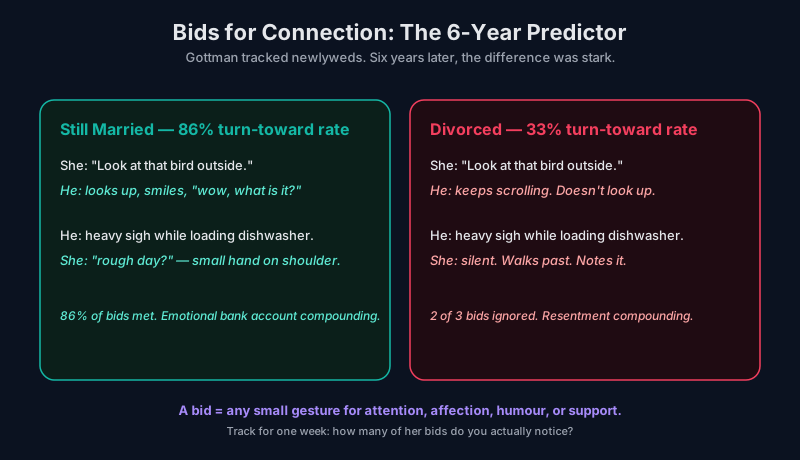
Newlyweds who were still together six years later had responded to 86% of bids with turning toward. Couples who divorced had responded to only 33%.
Two-thirds of the bids in failed marriages were going unanswered. The relationship was dying not from one big betrayal, but from a thousand tiny silences.
Why bids compound
Each successful bid is a small deposit in what Gottman calls the "emotional bank account." Years of these add up to a partner who feels seen and a relationship that can survive a real fight, a job loss, an illness.
Each missed bid is a tiny micro-rejection. Most won''t be remembered individually. But the body remembers. By year three, the partner whose bids keep getting ignored has stopped making them. That''s the silence people mistake for "we just grew apart."
How to track bids in nuttr
For one week, do this experiment:
- Set a daily reminder.
- Each evening, in Daily Tracker, log the count: how many bids did she make today, and how many did you turn toward?
- Don''t change your behaviour the first week — get a baseline.
- Week two, just notice bids in real time. The count usually doubles by itself.
Most men discover their baseline turn-toward rate is around 40–60%. Pulling that to 80% takes almost no effort once you''re seeing the bids in the first place. The leverage is enormous.
The flip side
You make bids too. Track whether she turns toward yours. A relationship where one person is doing all the bidding and the other all the receiving is a relationship with a clock on it.
Master this one skill and you''ll out-perform most couples on most days. It''s not romantic in a Hollywood way. It''s the boring, unglamorous, statistically-validated thing that actually keeps people together.
Further reading
- The 5:1 magic ratio is built one bid at a time
- The Four Horsemen show up after enough missed bids
- Love Maps: the long-term payoff of turning toward
Turning-toward rate is one of the strongest predictors in Gottman's research. Track it inside your compatibility score.
Related research
The Four Horsemen: Spotting Relationship Killers Early
Gottman identified four communication patterns that predict divorce with 94% accuracy. Here's how to spot — and track — them before you're six months deep.
The 5:1 Magic Ratio: Why Positive Interactions Matter
Stable couples maintain 5 positive interactions for every 1 negative. Couples headed for divorce sit near 0.8:1. Here's how to actually count.
Love Maps: How Well Do You Really Know Her?
Gottman's "Love Map" is the part of your brain that holds her inner world. Couples with detailed maps stay together. Here's how to build — and track — yours.