The Gottman Compatibility Score, Explained
What the Gottman Institute's four decades of research tell us about predicting relationship success — and how to score your own dating life against it.

Most "compatibility tests" are astrology with extra steps. The Gottman framework is different — it's built on 40+ years of longitudinal research at the University of Washington, where Drs. John and Julie Gottman observed thousands of couples and predicted divorce with up to 94% accuracy based on how partners interacted.
Here's what they found, and how you can score the people you date against it.
The Four Horsemen (the things that predict failure)
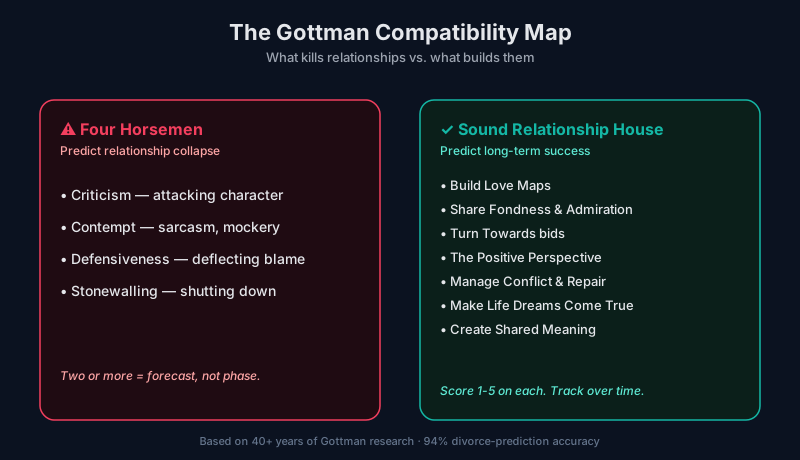
Gottman identified four communication patterns that, when they appear consistently, forecast relationship collapse:
- Criticism — attacking character ("you always…", "you never…") rather than behaviour
- Contempt — sarcasm, eye-rolling, mockery. The single biggest predictor of divorce.
- Defensiveness — refusing to take responsibility, deflecting blame
- Stonewalling — shutting down, withdrawing, going silent
If you spot two or more of these in early dating, it's not a phase. It's a forecast.
The Sound Relationship House (the things that predict success)
Gottman's positive framework is structured as a "house" of seven floors. The ones that matter most for early-stage compatibility:
- Build Love Maps — does she actually know you? Your fears, your dreams, your stresses?
- Share Fondness & Admiration — do you express what you appreciate, unprompted?
- Turn Towards instead of away — when she makes a small "bid" for attention, do you respond?
- The Positive Perspective — in moments of friction, is the default assumption charitable?
- Manage Conflict — can you disagree without contempt? Can you repair after a fight?
- Make Life Dreams Come True — do your individual ambitions fit into a shared future?
- Create Shared Meaning — values, rituals, traditions, a "we"
How to score it (without a clipboard)
You don't need a 200-question inventory. You need 15-ish honest data points, rated on a 1–5 scale, updated as the relationship reveals itself:
| Pillar | Sample metric |
|---|---|
| Communication | "I can tell her hard truths without it becoming a fight" |
| Conflict repair | "After a disagreement, we both come back to it within 24h" |
| Trust | "I never feel the need to check her phone" |
| Shared values | "We agree on kids, money, and how we'd raise them" |
| Sexual chemistry | "Physical intimacy feels mutual, frequent, easy" |
| Lifestyle fit | "Our weekends naturally look the same" |
Track 10–15 of these, and you have a single number from 0–100 that updates as you learn more. That's the per-partner compatibility score inside nuttr.
Why a score beats vibes
Three reasons:
- Memory is a liar. You'll romanticise the highs and forget the warning signs. A score forces you to record both.
- Patterns appear faster. A trend line of 4 sessions over 8 weeks shows you whether she's growing on you or wearing on you.
- Dealbreakers stop hiding. When trust scores 1/5 but chemistry scores 5/5, the framework forces the conversation you've been avoiding.
The hard part
The Gottman work is famous for one uncomfortable conclusion: compatibility is mostly about how you handle the bad days, not the good ones. Anyone can be charming on date three. The score that matters is the one that holds up at month nine.
That's the whole point of measuring it.
→ Try the compatibility score inside nuttr. Free, private, takes 90 seconds per session.
Further reading
- The Four Horsemen: relationship-killing patterns Gottman can predict divorce from
- The 5:1 magic ratio: why positive interactions need to outnumber negatives
- Attachment styles: how anxious, avoidant, and secure patterns play out in dating
Want to see this play out with someone you're dating? Run the Gottman-inspired compatibility score and track the patterns over time.
Related research
The Four Horsemen: Spotting Relationship Killers Early
Gottman identified four communication patterns that predict divorce with 94% accuracy. Here's how to spot — and track — them before you're six months deep.
The 5:1 Magic Ratio: Why Positive Interactions Matter
Stable couples maintain 5 positive interactions for every 1 negative. Couples headed for divorce sit near 0.8:1. Here's how to actually count.
Attachment Styles & Compatibility: A Tracker's Guide
Anxious, avoidant, secure, disorganized — your attachment style is the lens you read every signal through. Here's how to identify hers and yours, and what the data tells you about long-term odds.