Attachment Styles & Compatibility: A Tracker's Guide
Anxious, avoidant, secure, disorganized — your attachment style is the lens you read every signal through. Here's how to identify hers and yours, and what the data tells you about long-term odds.

Attachment theory started with infants and their mothers, but Hazan and Shaver showed in 1987 that the same patterns play out in adult romantic relationships. Roughly:
- ~50% of adults are secure
- ~20% are anxious (preoccupied)
- ~25% are avoidant (dismissive)
- ~5% are disorganized (fearful-avoidant)
Style isn''t destiny — it''s shaped by early relationships and updated by current ones. But it''s the single most useful lens for reading why she does what she does.
How each style behaves under stress
Secure — comfortable with closeness and independence. Comes back to talk after a fight. Doesn''t panic when you don''t text for 4 hours.
Anxious — craves closeness, hyper-vigilant for signs of withdrawal. Reads delays as rejection. Can become demanding or sulky when needs aren''t met. Often the "why are you being weird?" texter.
Avoidant — values independence, finds intimacy suffocating. Distances when things get serious — picks fights, finds flaws, ghosts emotionally. The classic "needs space" pattern.
Disorganized — wants closeness and fears it. Pulls in then pushes away unpredictably. Often connected to trauma; usually needs therapy to stabilise.
The compatibility matrix
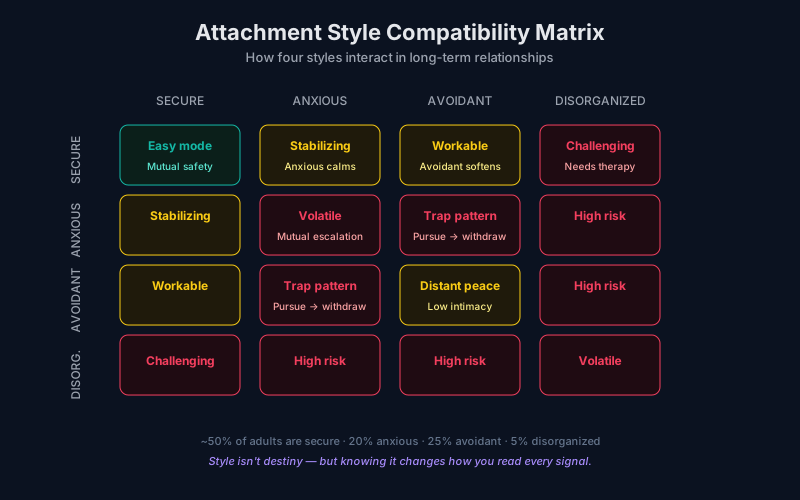
The bad news: anxious + avoidant is the most common pairing and the most painful one. The anxious partner pursues, the avoidant withdraws, the pursuit intensifies, the withdrawal hardens. It feels like chemistry. It''s actually trauma bonding.
The good news: secure + anything (except disorganized) is workable. A secure partner can co-regulate an anxious or avoidant one over time. Two secures is the easiest mode.
How to identify her style (without asking outright)
Track these in nuttr''s Compatibility notes after the first 5–8 dates:
- How does she behave when you don''t reply for 6 hours? Anxious will escalate. Avoidant won''t notice. Secure will assume you''re busy.
- How does she handle a small disagreement? Anxious gets emotional and needs reassurance. Avoidant goes cold or changes the subject. Secure stays present.
- Can she talk about her exes without contempt? Secures can be honest and balanced. Avoidants often dismiss. Anxious often still emotionally entangled.
- What was her relationship with her parents like growing up? Not destiny, but a strong tell.
Tracking over time
Add an attachment observation to each compatibility session. After a month of data, the pattern is usually obvious — and so is yours.
The point isn''t to disqualify anyone. It''s to know what you''re working with so you stop misreading her behaviour as personal when it''s structural — and so you can decide whether you have the bandwidth for the work it''ll take.
Further reading
- Bids for connection: how attachment styles show up in everyday moments
- The Four Horsemen often map to attachment wounds
- The Gottman compatibility framework, explained
Log your own and her likely attachment style in your compatibility score — patterns get obvious fast once you're tracking.
Related research
The Four Horsemen: Spotting Relationship Killers Early
Gottman identified four communication patterns that predict divorce with 94% accuracy. Here's how to spot — and track — them before you're six months deep.
The 5:1 Magic Ratio: Why Positive Interactions Matter
Stable couples maintain 5 positive interactions for every 1 negative. Couples headed for divorce sit near 0.8:1. Here's how to actually count.
Love Maps: How Well Do You Really Know Her?
Gottman's "Love Map" is the part of your brain that holds her inner world. Couples with detailed maps stay together. Here's how to build — and track — yours.