Cost Per Nut: The Complete Guide (2026)
The definitive guide to Cost Per Nut — what it is, how to calculate it, what's a good CPN, how to lower it, and why it's the most honest metric in modern dating. Updated 2026.

Cost Per Nut (CPN) is the single most honest metric in modern dating. It tells you, in plain dollars, what every encounter with a particular woman is actually costing you — once you strip out the ego, the chemistry, and the stories you tell yourself.
This is the complete 2026 guide: what CPN is, how to calculate it, what counts as a "good" number, how to track it without becoming weird about it, and how to use it to make better decisions about who you date.
If you only read one piece on cost per nut, make it this one.
Table of contents
- What is Cost Per Nut?
- The CPN formula
- What counts as spend (and what doesn't)
- What's a good CPN? Benchmarks
- Why CPN beats every other dating metric
- How to track it
- How to lower your CPN
- CPN + compatibility: the 2×2 that matters
- Common mistakes
- FAQ
What is Cost Per Nut?
Cost Per Nut is the unit-economics of your dating life: total dollars spent on a person divided by total intimate encounters with that person. It produces a single number — the price you're paying, in cash, per moment of intimacy.
It sounds crude. That's the point. The crudeness is what cuts through the rationalisations.
Most dating advice operates in the language of feelings — do you have a connection? do you see a future? Those questions matter, but they're impossible to answer honestly in the middle of an infatuation. CPN is the opposite kind of question: cold, numerical, impossible to argue with.
A spreadsheet doesn't care that she's "different." It just shows you what she actually costs.
The CPN formula
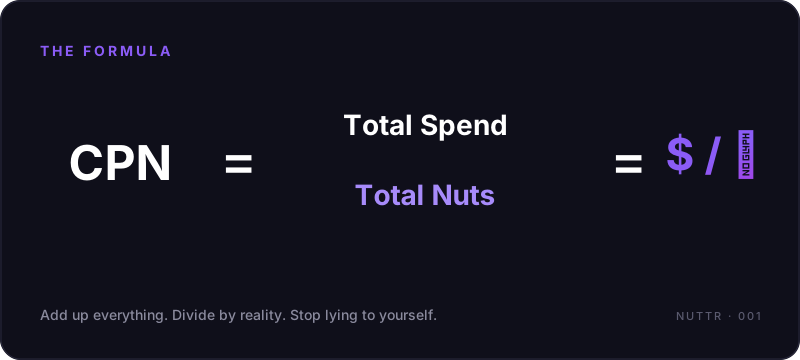
That's it. Two inputs, one output. Track both, divide, done.
The math is trivial. The discipline of actually logging both — every dollar, every nut, in real time — is where 95% of people fail.
What counts as spend (and what doesn't)
The biggest mistake new CPN trackers make is under-counting. You'll dramatically lowball your number unless you include everything below.
Always count:
- Restaurants, bars, drinks, coffee
- Uber/Lyft/cabs to and from her
- Gifts, flowers, "small" treats
- Her share of trips, hotels, Airbnbs
- Concert/event tickets where she's the reason you went
- Subscriptions/services bought for her benefit (Netflix sharing, gym day pass, etc.)
- Cooked-at-home dates (yes — count the groceries)
Generally don't count:
- Things you'd have bought for yourself anyway
- Investments in you that incidentally impressed her (gym membership, new clothes)
- Time, although track hours separately if you want a true picture
A useful rule: if she wasn't in your life, would this charge exist? If no — it's CPN spend.
What's a good CPN? Benchmarks
There's no universal "good" number, but the buckets most users settle into look like this:
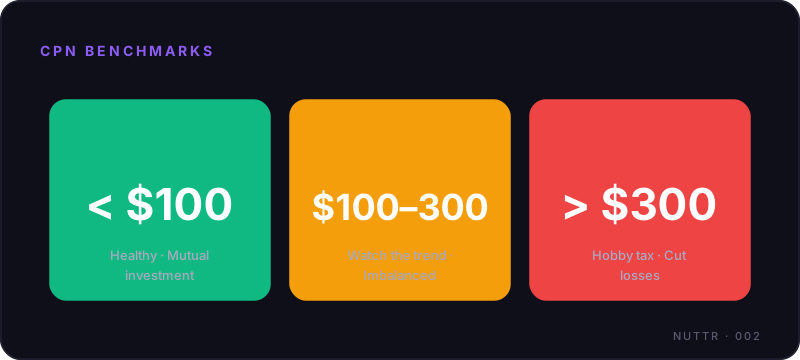
Context shifts these:
- Long-distance legitimately pushes CPN into the amber/red zone for the first 3–6 months
- High-cost cities (NYC, SF, London) shift baselines up across the board — see our average CPN by city benchmarks
- Early courtship is supposed to be expensive; the question is whether the trend bends down
The real signal isn't the snapshot — it's the slope.
Why CPN beats every other metric
Three reasons CPN is more useful than vibes, time spent, date count, or any other dating proxy:
- It's comparable. $180 with one woman vs $40 with another tells you something real, immediately, regardless of how different they are.
- It's trend-able. A rising CPN over 8 weeks is an early warning that effort and outcome have decoupled. You'll feel this 3 months later. The number sees it now.
- It's emotion-proof. You can lie to your therapist. You can lie to your friends. You cannot lie to a sum and a count.
A healthy CPN trajectory looks like this:
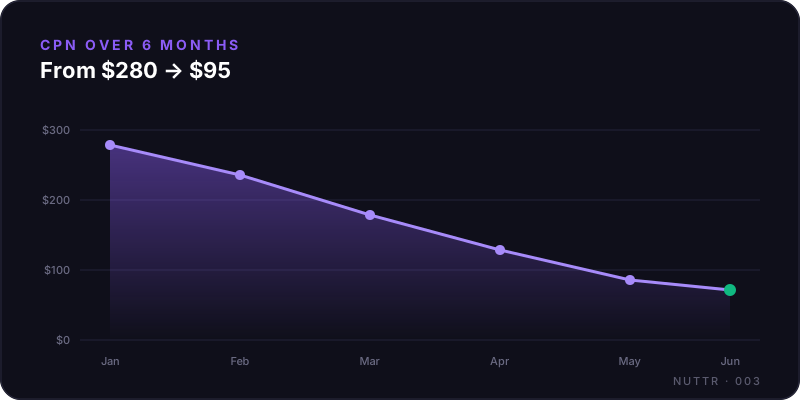
That curve is the data signature of a relationship that's actually working. You're investing less per encounter as intimacy becomes mutual, frequent, and real.
How to track it
You have three serious options. (Pen and paper works but you'll abandon it by week two.)
- Spreadsheet (Google Sheets / Notion). Maximum control, zero cost, painful UX. Best for people who already live in spreadsheets.
- Generic budget app + manual tagging (YNAB, Copilot). Better than spreadsheets for spend, but doesn't track nuts or compatibility.
- A purpose-built CPN tracker. nuttr is the one we make. Free, mobile-first, private. There's a side-by-side comparison of the main options if you want to evaluate.
Whichever you pick, the workflow is the same:

The full step-by-step is in How to Track Your Cost Per Nut.
How to lower your CPN
Without becoming a cheapskate (which she'll notice and which will tank your CPN further by killing the "nuts" denominator):
- Front-load quality, back-load cost. First 2–3 dates: impressive but cheap (interesting walk + a great cocktail bar > $200 dinner). Save the expensive moves for established mutual investment.
- Track in real-time. People who log spend within 24 hours report numbers ~30% higher than people who guess at month-end. The shame is the signal.
- Watch the asymmetry. If she never plans, never pays, never hosts — your CPN is forecasting a future you don't want.
- Don't substitute money for effort. Booking a $400 restaurant when you could've planned a thoughtful $40 evening is the single most common CPN-killing move men make.
CPN + compatibility: the 2×2 that matters
CPN alone is incomplete. A low CPN with someone you'd never marry isn't a win — it's just a cheap fling. A high CPN with the love of your life is just the down payment.
You need to plot CPN against a real compatibility score. The simplest version:
| Low compatibility (<60) | High compatibility (≥60) | |
|---|---|---|
| Low CPN (<$100) | Casual fling — fine, don't escalate | 🟢 Keep going. Investment is paying off. |
| High CPN (>$300) | 🚨 Hobby tax. Cut losses. | Long-distance / early courting. Watch the trend. |
The Gottman-based compatibility score inside nuttr gives you the second axis. The combination is what tells you whether to escalate, hold, or exit.
Common mistakes
- Only counting big-ticket items. The $400 dinner is memorable. The 14 Ubers, 9 coffee dates, and 3 "small" gifts that month aren't — and they're usually 2× the dinner.
- Tracking spend but not nuts. A budget app gives you the numerator. Without the denominator, you've measured nothing useful.
- Resetting too often. CPN takes 4–6 weeks of data to be meaningful. Don't panic-evaluate at week 2.
- Confusing low CPN with quality. A woman who never lets you spend on her can be amazing — or she can be checking out. CPN doesn't distinguish; compatibility scoring does.
- Hiding the number from yourself. Don't average across all women if one is dragging the rest. Track per person.
FAQ
Is calculating CPN disrespectful? Tracking your own spending isn't disrespectful — it's adult. You're not rating her, you're auditing yourself. She never sees the number.
Should I share my CPN with my partner? Almost never. CPN is a tool for your decision-making, not a conversation starter. The exception: a long-term partner who'd appreciate that you've been thoughtful about reciprocity.
What if I genuinely don't care about money? Then use CPN as a proxy for effort asymmetry instead of dollars. The dollar number is just the easiest input to track — the underlying signal is whether one of you is investing dramatically more than the other.
Does CPN work for relationships, not just dating? Yes — and the bar shifts. Inside a real relationship, CPN converges toward something near zero (you're sharing a life, not transacting). A rising CPN inside a long-term relationship is a major warning sign about reciprocity.
Is there a free CPN tracker? Yes — nuttr is free. Track every date, every dollar, every nut, and get your CPN per person, per month, all-time, automatically.
Track your real CPN in 30 seconds
You've read the theory. Now look at your actual number. → Try nuttr free. No card, mobile-first, your data stays yours.
The number won't lie to you. The question is whether you're ready to look.
Related research
Top 7 Ways to Keep Your Cost Per Nut Down in 2026
Seven practical, data-backed levers to lower your Cost Per Nut without becoming a cheapskate. Real numbers, real tradeoffs.
8 Top Ways to Keep Dating Cheap (Without Looking Cheap)
Eight cheap date ideas with real average costs. How to date well on under $25 without signaling you're broke.
5 Ways to Track Your Cost Per Nut (Ranked by Effort vs. Accuracy)
From a notes app to a purpose-built tracker — five real ways to measure your Cost Per Nut, with the tradeoffs of each.