How to Track Your Cost Per Nut in 2026 (Step-by-Step)
A practical, no-fluff guide to tracking Cost Per Nut. Setup in 5 minutes, exact fields to log, common mistakes, and the daily 20-second routine that makes it stick.
If you've decided that Cost Per Nut is worth measuring, the next question is the only one that matters: how do you actually track it without it becoming a chore you abandon by week two?
This guide walks you through the exact setup, the exact fields to log, the daily 20-second routine, and the mistakes that kill 90% of CPN-tracking attempts before month one.
The 4-step tracking loop
Every functional CPN system — whether you build it in a spreadsheet or use a purpose-built app — follows the same loop:

The order matters. If you try to log nuts before dates, you'll forget context. If you log spend at month-end, you'll miss 30%+ of it.
Step 1 — Pick your tool (5 minutes)
You have three real options:
Option A: Google Sheets / Notion
Build a sheet with columns: Date | Person | Type (Date/Nut) | Amount | Vibe (1–5) | Notes. Add a pivot table that sums spend per person and counts nuts per person, then divides. Total setup time: 30 minutes if you know spreadsheets, 2 hours if you don't.
Pros: Free, total control, exportable. Cons: Friction. Every. Single. Entry. You'll quit by week three.
Option B: Generic budget app (YNAB, Copilot, Mint)
Tag every dating-related transaction with a custom category. Most won't track encounters, so you'll need a separate count somewhere.
Pros: Half the workflow is automatic if your bank is connected. Cons: Doesn't track nuts, doesn't compute CPN, no per-person view.
Option C: A purpose-built CPN tracker
Use an app designed for this. nuttr is the one we make — it's free, mobile-first, and computes CPN per person automatically. There's a comparison of all the main options here.
Pros: Zero friction. The whole loop is one screen. Cons: You're trusting your dating data to a third party. (For nuttr specifically: data stays in your private account, never sold, exportable.)
For most people we'd recommend Option C. The friction reduction is the difference between a system that works and a spreadsheet you abandon.
Step 2 — Log the date (10 seconds)
The fields you actually need:
| Field | Why it matters |
|---|---|
| Who | Per-person CPN is the only useful CPN. Aggregate is meaningless. |
| When | Monthly trends require dates. |
| Where | "Bar" vs "her place" patterns reveal who initiates intimacy. |
| Vibe (1–5) | Cheap proxy for compatibility before you set up real scoring. |
| Total cost | The whole night, not just the dinner. |
Skip notes unless something specific happened. Notes feel valuable when you write them and almost never get re-read.
Step 3 — Log the spend (real-time, not month-end)
This is the one rule that separates working CPN systems from broken ones:
Log every dollar within 24 hours of spending it.
Real-world data on this is unambiguous: month-end estimates undercount actual spend by 25–35%. The Ubers, the small drinks, the "I'll get this round" all evaporate from memory. Tracking in real-time is the only way the number reflects reality.
Three tactics that make real-time logging stick:
- Trigger on the receipt. Every time you tap your card, the next 30 seconds is for logging. Make it reflexive.
- Open the app on the cab home. Most dates end with a ride. Use it.
- Round up, never down. If you're not sure whether a charge was $42 or $46, log $46. Optimistic bias kills accuracy.
Step 4 — Log the nut (same day)
The fields that actually matter:
| Field | Why |
|---|---|
| Date | Without it, you can't compute monthly frequency. |
| Count | Multiple in one night is one entry, count = N. |
| Experience (1–5) | Frequency × quality is the real outcome metric. |
If logging this feels weird, remember: you're tracking your own behaviour and outcomes, not rating her. Nobody else sees this.
Step 5 — Read the chart, not the number
A single CPN snapshot is almost meaningless. The trend is everything.
Look at this pattern:
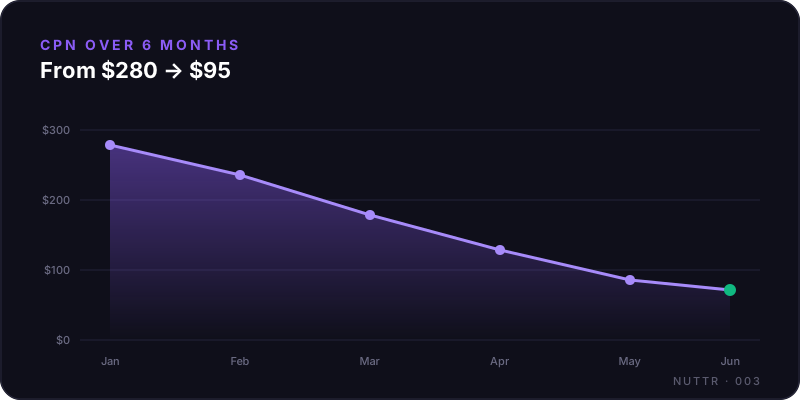
That curve is the data signature of a real connection forming — investment per encounter dropping as intimacy becomes mutual. If your trend looks the opposite (rising over months), you're paying more for the same thing, which is the canonical hobby-tax pattern.
Three patterns to watch for:
- Declining slope — healthiest signal there is
- Flat with low CPN — established, balanced, fine
- Rising slope after month 3 — start asking hard questions
The daily routine that makes it stick
The whole system is two micro-habits:
- After every charge: open app → log spend → close. ~15 seconds.
- End of every day with her: open app → log nut (or skip if none) → close. ~10 seconds.
That's it. No weekly review, no Sunday spreadsheet ritual. The friction has to be lower than the friction of not doing it, or it dies.
The 4 mistakes that kill 90% of CPN tracking
- Starting too granular. Don't log mood, weather, position, conversation topics on day one. Just dates, dollars, nuts. Add complexity once the basics stick for 30 days.
- Aggregating across women. Per-person CPN is the only useful view. Total CPN tells you nothing about which relationship is the leak.
- Hiding the number from yourself. Some people stop logging when CPN gets ugly. That's exactly when the number is most valuable.
- No compatibility axis. CPN without compatibility is half a picture. A high CPN with a 90/100 compatibility score is investment. The same CPN with a 35/100 score is a tax.
Set yours up in 30 seconds
nuttr is the fastest path from "I want to track this" to having a real CPN per person. Free, mobile-first, your data stays yours.
→ Start tracking free — no card required.
Or read the complete CPN guide for the full theory.
Related research
The 5 Best Cost Per Nut Trackers in 2026
We compared every credible Cost Per Nut tracker — purpose-built apps, spreadsheets, budget apps, and journals — across tracking, compatibility scoring, charts, privacy, and price. Here's the ranked shortlist.
How to Track Dating Spend Without Being Weird About It
A practical, non-cringe guide to tracking what you spend on dating. Categories that matter, the tools that work, the mistakes that make it weird, and how it actually improves your dating life.
What is Cost Per Nut? The Honest Dating Spend Metric
Cost Per Nut (CPN) is the unit economics of your dating life — total spend divided by total encounters. Here's how to calculate it, why it matters, and how to lower it.