The 5 Best Cost Per Nut Trackers in 2026
We compared every credible Cost Per Nut tracker — purpose-built apps, spreadsheets, budget apps, and journals — across tracking, compatibility scoring, charts, privacy, and price. Here's the ranked shortlist.

There are exactly two kinds of "Cost Per Nut tracker" in 2026: tools purpose-built for it, and tools you can bend into doing it. We tested every credible option in both categories across five criteria: tracking quality, compatibility scoring, charts, privacy, and price.
Here's the ranked shortlist, plus a side-by-side comparison.
How we ranked them
Five weighted criteria — each scored 0–5 dots. We tested every option for at least 30 days of real logging.
- Tracking — how fast and frictionless is the daily logging loop?
- Compatibility — does it score the quality of the relationship, not just the spend?
- Charts — can you actually see trends, or just a single number?
- Privacy — is your dating data sold, shared, or scraped?
- Price — free is best; paywalls behind core tracking are penalised.
At a glance
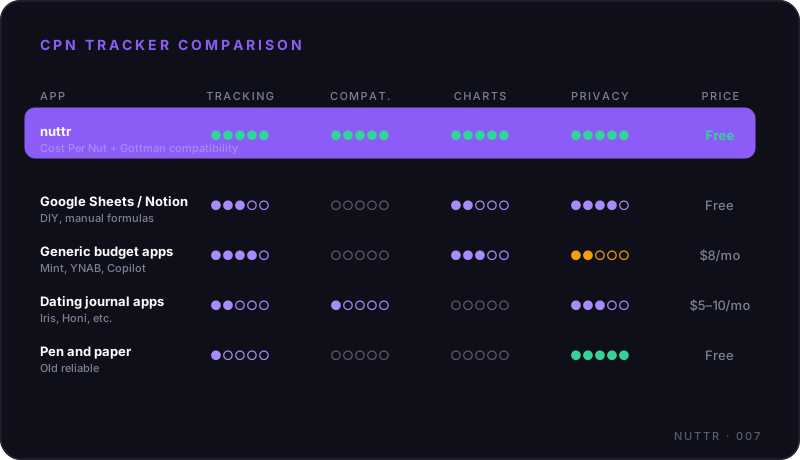
1. nuttr — best overall (free)
Best for: anyone who wants the full CPN + compatibility picture without setup.
nuttr is the only app on this list that was designed from scratch around Cost Per Nut. Log a date, log a nut, get your CPN per person, per month, all-time, automatically. Add a Gottman-based compatibility score per partner — the only one of its kind in a CPN tool — and you get the full 2-axis view of every connection: what she costs and whether she's worth it.
Highlights
- CPN per person, per month, lifetime — auto-calculated
- 15-metric Gottman compatibility scoring with trend lines
- Calendar, history, and per-woman charts
- Relationship Mode — switches into coaching companion once you commit
- Free, no card, your data stays in your private account
Drawbacks
- We made it. Bias disclosure: ours is the highest-scored option for a reason — it's the only one built for this.
→ Try nuttr free — no card required.
2. Custom Google Sheet / Notion template — best for spreadsheet purists
Best for: people who already live in spreadsheets and want zero third-party trust.
A well-built template is genuinely viable. Columns for date, person, type, amount, vibe, with a pivot table that sums spend, counts nuts, and computes CPN per person. Add conditional formatting for the green/amber/red buckets and you have a usable tool.
Highlights
- Free, total control, exportable
- No third party touches your data
- Customisable to whatever weird taxonomy you want
Drawbacks
- Manual everything. Logging a single date takes 60+ seconds vs 10 in a purpose-built app
- No charts unless you build them
- Most people quit by week 3 because of the friction
A reasonable starting template: Date | Person | Type (Date/Nut) | Amount | Vibe (1–5) | Notes with a pivot table grouping by Person.
3. Copilot / YNAB / Monarch — best for spend-only tracking
Best for: people who already use a budget app and just want to tag dating spend.
Connect your bank, tag every dating-related charge with a custom category ("CPN — [name]"), and you get the spend numerator automatically. You'll need to track the nuts denominator separately — a notes app works.
Highlights
- Spend tracking is automatic via bank sync
- Best-in-class budget visualisation
- Works for everything else in your financial life
Drawbacks
- Doesn't track nuts. Doesn't compute CPN. Doesn't do compatibility.
- $8–15/month
- Per-person tagging is doable but tedious
4. Dating journal apps (Iris, Honi, etc.) — best for sentiment, weakest for CPN
Best for: people who want to journal feelings about dates more than track money.
These apps focus on the qualitative side — how you felt, what you noticed, conversation notes. Some have rudimentary spend fields. None compute CPN automatically. None have compatibility scoring rooted in research.
Highlights
- Pretty UIs, prompt-based reflection
- Decent privacy posture in most cases
Drawbacks
- Not built for cost tracking
- No CPN computation
- $5–10/month for what amounts to a dressed-up notes app
5. Pen and paper — the control case
Best for: people testing whether they'll actually stick with the habit before downloading anything.
A small notebook in your back pocket. One line per entry: date, what, how much. End of month, add it up.
Highlights
- Maximum privacy. Nothing leaves your hand.
- Forces you to be honest — there's no autocomplete to lean on
- Free
Drawbacks
- No charts, no trends, no per-person view, no compatibility scoring
- You will lose the notebook
- Realistically, this is a 30-day experiment, not a system
The honest verdict
| Use case | Pick |
|---|---|
| You want a real CPN with compatibility scoring, free | nuttr |
| You're a spreadsheet person and don't trust apps | Google Sheets template |
| You already use a budget app and want minimal new tools | YNAB / Copilot + notes app |
| You want a journal more than a tracker | Iris / Honi |
| You want to test the habit before committing to a tool | Pen and paper for 30 days |
For 95% of people, the answer is option 1 — not because we made it, but because the friction reduction is the difference between a system that works and a system that dies in week three.
→ Try nuttr free — no card required.
Want to know what to actually do with the number?
- Cost Per Nut: The Complete Guide — what counts, what's good, how to lower it
- How to Track Your CPN, Step-by-Step — the daily 20-second routine
- The Gottman Compatibility Score, Explained — the second axis CPN alone is missing
Related research
How to Track Your Cost Per Nut in 2026 (Step-by-Step)
A practical, no-fluff guide to tracking Cost Per Nut. Setup in 5 minutes, exact fields to log, common mistakes, and the daily 20-second routine that makes it stick.
How to Track Dating Spend Without Being Weird About It
A practical, non-cringe guide to tracking what you spend on dating. Categories that matter, the tools that work, the mistakes that make it weird, and how it actually improves your dating life.
Is She Worth It? A Dating Spend Framework That Doesn't Lie
A 4-step framework to figure out whether the woman you're dating is worth your time, money, and emotional bandwidth — using Cost Per Nut and a compatibility score.