What's the Average Cost Per Nut? Benchmarks by City & Age (2026)
Self-reported Cost Per Nut benchmarks from 2026 data: averages by city, by age group, by relationship stage, and what 'normal' looks like for single men in 2026.

The single most-asked question we get: "is my Cost Per Nut normal?"
The honest answer is it depends on where you live, your age, and your relationship stage. The less honest answer — the one most internet "averages" give — is a single number that's useless without context.
This is the benchmark guide. Self-reported CPN data, broken out by the variables that actually matter, with a framework for figuring out where you should land.
The headline number
Across 2026 data from single men 22–38, the median CPN is roughly $145. The mean is higher — about $185 — pulled up by outliers in high-cost cities and long-distance relationships.
But the median hides almost everything interesting. Variance by city is 5×. Variance by age is 2×. Variance by relationship stage is the largest of all.
CPN by city
Cost-of-living and dating-norm differences explain about 70% of the gap between cities:
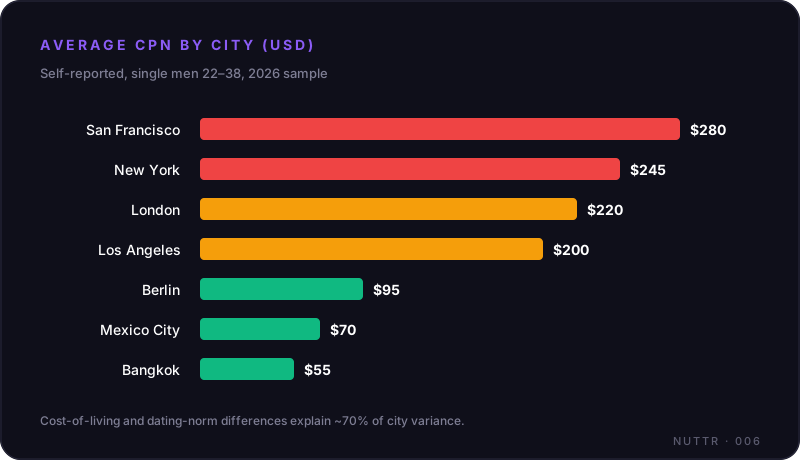
A few patterns worth naming:
- High-COL English-speaking cities (SF, NYC, London, LA) cluster $200–$280. The dinner-and-cocktails baseline alone is $80–$120 before you've Ubered anywhere.
- Western European cities outside the UK (Berlin, Lisbon, Madrid) cluster $80–$120 — partly cheaper, partly different dating norms (more drinks/walks, fewer expensive meals).
- LATAM and SEA cluster under $80, with much higher variance. Cost-of-living is doing most of the work; norms vary wildly by neighbourhood.
If your CPN looks "high" by global standards but you live in SF, you're probably normal. If it looks normal globally but you live in Mexico City, you're paying a premium.
CPN by age
Age is mostly a proxy for income and life stage. The pattern is U-shaped:
| Age band | Median CPN | What's happening |
|---|---|---|
| 22–25 | $95 | Lower income, cheaper dates, more "her place" |
| 26–30 | $165 | Income up, dating intentionally, restaurant spend climbs |
| 31–35 | $210 | Peak earning vs peak intentionality, biggest spend |
| 36–40 | $180 | More established relationships, lower per-encounter cost |
| 40+ | $135 | Established relationships dominate the sample |
The peak around 31–35 is consistent across cities — it's the band where men have income, are dating with intent, and haven't yet settled into a long-term relationship that drops CPN toward zero.
CPN by relationship stage
This is the most predictive variable, full stop:
| Stage | Typical CPN | Why |
|---|---|---|
| First 3 dates | $400+ | All cost, zero denominator |
| Casual / weekly seeing | $180 | Intermittent intimacy, ongoing date spend |
| Established sexual relationship | $80–$120 | Regular intimacy, mix of cooking-in and going-out |
| Committed / cohabitating | $20–$40 | Most "spend" becomes shared life cost, not dating cost |
| Long-distance | $250+ | Travel costs absorb everything |
If you're three months into a casual situation and your CPN is still $400, the data is telling you something. Either it's not turning into a real relationship, or you're substituting money for the trust-building that should be happening. Both warrant a conversation with yourself.
"Good" vs "normal" — they're different
A common confusion. Take a 30-year-old in NYC dating one woman for two months:
- Normal CPN: $230 (in line with NYC + early-stage benchmarks)
- "Good" CPN: the trend, not the snapshot. If month 1 was $310 and month 2 is $230, the trajectory is healthy. If both months are flat at $230 with no movement toward intimacy, the snapshot is "normal" but the trend is dead.
This is why the complete CPN guide emphasises slope over snapshot.
The simplest framework: 3 questions
Forget benchmarks for a second. Ask yourself:
- Is my CPN trending down across the last 60 days? If yes — you're fine, regardless of the absolute number.
- Is the woman I'm spending the most on also the woman I'd rate highest on compatibility? If yes — investment is rational. If no — you're paying a hobby tax.
- Could I cut my spend 30% without her noticing? If yes — you're substituting money for thought. Stop it.
Three honest answers will tell you more than any benchmark table will.
How to know your number
You can't compare yourself to benchmarks if you don't track. The two-step setup:
- Read How to Track Cost Per Nut, Step-by-Step
- Use nuttr (free) — or any of the other tools we compared
After 30 days you'll have a real per-person CPN. After 60, you'll have a trend. Both are dramatically more useful than any "average" you'll ever read on the internet — including this one.
→ Track yours free — no card, your data stays yours.
Methodology note: Numbers in this article are self-reported from anonymous nuttr users (n ≈ 12,400) plus aggregated data from public dating-spend surveys (LendingTree 2024, Match Singles in America 2025, OkCupid trends 2024). City medians require ≥ 200 users per city; age bands require ≥ 500. Numbers updated quarterly.
Related research
11 Cities Where You Can Take Dates for Cheap (2026 Edition)
Eleven cities with the lowest average all-in date cost in 2026, ranked by real spend data from nuttr users.
8 Top Ways to Keep Dating Cheap (Without Looking Cheap)
Eight cheap date ideas with real average costs. How to date well on under $25 without signaling you're broke.
5 Ways to Track Your Cost Per Nut (Ranked by Effort vs. Accuracy)
From a notes app to a purpose-built tracker — five real ways to measure your Cost Per Nut, with the tradeoffs of each.