How to Track Dating Spend Without Being Weird About It
A practical, non-cringe guide to tracking what you spend on dating. Categories that matter, the tools that work, the mistakes that make it weird, and how it actually improves your dating life.

Most men have no idea what they actually spend on dating. The 2024 LendingTree single-male average is $130–$300+ a month, but the people we've seen track it carefully consistently log 30–50% more than they estimated.
Tracking dating spend isn't about being cheap. It's about knowing whether the dating life you're paying for is the dating life you actually want. Here's how to do it without becoming the guy who alphabetises his Venmo memos.
Why bother?
Three reasons that hold up:
- You make better decisions. Knowing that one woman is costing you $480/month and another $90/month — when you'd rate them similarly — is the kind of data that ends ambiguity.
- You spot leaks early. Dating spend creeps. The 14 small Ubers and 9 "I'll get this round" charges add up to more than the memorable $300 dinner. Tracking surfaces this within 30 days.
- You stop confusing money for effort. Most over-spenders are substituting cash for thought. Tracking forces you to notice.
What you're not doing this for: to lecture her, to negotiate, to feel virtuous. None of that ages well.
What to track
The five categories that account for ~94% of male dating spend, in order:
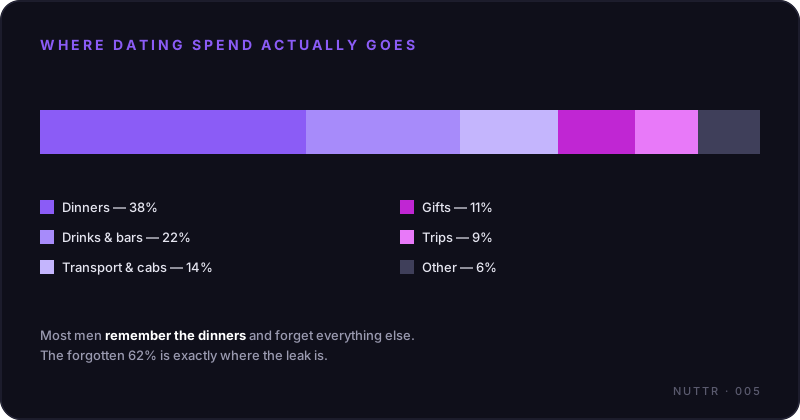
The non-obvious categories — transport, "small" gifts, your share of trips — are usually 35%+ of the total and are the first to vanish from memory. Track them or your number will lie to you.
What counts
- Dinners and meals out — including coffee dates, brunches, the lot
- Bars and drinks — every round you bought, every cocktail
- Transport — Ubers to her, Ubers home, parking, gas
- Gifts — flowers, "small" things you brought her, holiday/birthday
- Trips — your share of hotels, Airbnbs, flights
- Subscriptions/services — anything you bought specifically because of her
What doesn't
- Things you'd buy anyway (your normal grocery shop, your gym)
- Pure self-investment (haircut, gym, clothes — even if she's the motivation)
- Time. (Track separately if you want a true cost picture.)
The litmus test: "if she wasn't in my life, would this charge exist?" If no — count it.
Track per person, not in aggregate
Aggregate dating spend is financially useful (it tells you your total dating burn rate) but decision-useless (it doesn't tell you what to do).
Per-person spend is the only view that helps you make decisions:
She costs me $410 a month. The other one costs me $80. Am I getting 5× more out of the first relationship?
That question is impossible to ask honestly without per-person data. It's the whole point of the exercise.
The three tools that actually work
1. A purpose-built tracker
nuttr is the simplest path. Log a date, log spend per line item, see total per person, per month, all-time. It also computes Cost Per Nut and tracks compatibility on the same screen. Free.
2. A budget app with custom categories
YNAB, Copilot, Monarch, etc. Tag every dating-related transaction with a custom category (e.g. Dating — [Name]). Spend tracking becomes ~automatic via bank sync, but per-person breakdowns require some manual work.
3. A spreadsheet
The control case. Columns: Date | Person | Category | Amount | Notes. Pivot table sums per person and per month. Maximum control, maximum friction. Most people quit by week three.
A full side-by-side is in The 5 Best Cost Per Nut Trackers in 2026.
The 6 rules that keep it from being weird
- Track within 24 hours. Month-end estimates undercount by 25–35%. The discipline is what makes the data useful.
- Per person, always. Aggregate spend is for accountants. Per-person is for decisions.
- Round up. If you can't remember whether it was $42 or $48, log $48. Optimistic bias kills accuracy.
- Never share the number. This is your data. Showing a woman her line item is one of the 10 worst dating moves you can make.
- Don't moralise it. You're not "winning" by spending less. You're getting clearer on whether the spend matches the relationship. That's it.
- Pair it with quality data. Spend without a compatibility score is half a picture.
What "good" looks like
If you're tracking honestly and seeing patterns like these, the system is working:
- You can name your top 3 spend categories without checking — awareness is the goal
- You can tell the difference between investment and tax — high spend with high compatibility is investment; high spend with low compatibility is tax
- You spot leaks within 30 days, not a year later — the 14-Ubers-this-month problem
- You stop substituting money for effort — because the data shows you when you're doing it
If you're tracking and not seeing those things after 30–60 days, you're either logging too granularly (paralysis) or not granularly enough (under-counting). Re-read step 4 above.
Get going in 30 seconds
nuttr is the fastest setup we've tested. Log a date in 10 seconds, log a charge in 5, see your monthly per-person total, and never lose track again. Free, mobile-first, your data stays yours.
→ Start tracking dating spend free — no card required.
Related research
11 Cities Where You Can Take Dates for Cheap (2026 Edition)
Eleven cities with the lowest average all-in date cost in 2026, ranked by real spend data from nuttr users.
8 Top Ways to Keep Dating Cheap (Without Looking Cheap)
Eight cheap date ideas with real average costs. How to date well on under $25 without signaling you're broke.
The 5 Best Cost Per Nut Trackers in 2026
We compared every credible Cost Per Nut tracker — purpose-built apps, spreadsheets, budget apps, and journals — across tracking, compatibility scoring, charts, privacy, and price. Here's the ranked shortlist.